Hi - We're going to get passionate about the environment; so, grab a beverage, take your shoes off, sit down and get comfy. If global warming is an interest of yours - add your comments, subscribe to the feed and/or become a follower. Don't forget to check out the ads to the right side of the column. There is some very interesting material to be had there. Read, comment, enjoy!!!
Sometimes being Canadian doesn't feel so good. Canada has made a controversial move; and, I fear it is another giant step forward in the race to a world-wide diet made up entirely of GMOs. These piglets may look harmless enough; but, they are harbouring a dirty little secret inside those cuddly pink bodies. These piglets are genetically modified.
Canada has approved limited production of animals dubbed "enviropigs™," a genetically modified breed of pigs producing up to 65% less phosphorous in pig poo and urine. The genetic modification is so complete these pigs pass the ability to produce less phosphorous along to their young.
The very idea that a genetically modified animal rates the moniker "enviro-" points to the severity of the issue addressed by the science behind these pigs. It also raises the spector of nature run amok due to all these artifical changes to their physiology.
Phosphorous is a fertilizer found in animal and human wastes, which runs off or discharges to surface waters, where it spurs large algal blooms. The algae use up the oxygen in the water, leaving behind a "dead zone," an area of lake, river, or ocean where nothing can live due to the hypoxic (oxygenless) conditions.
How does the enviropig work (image in extended)? And does the dead zone problem justify permitting production of these "franken-pigs"?
This video is slightly over 11 minutes in length; but, gives a good overall view of gmos.
The genetic modification used by scientists at the University of Guelph, Ontario involves an enzyme known as phytase. Phosphorous plays an essential role in the growth of bones, construction of DNA and RNA, and in regulating cell and organ processes. But most of the phosphorous in a grain-based diet are bound up as organic complexes which pigs cannot digest. Supplementing pig diets with phytase, itself produced from genetically modified fungi Aspergillus Niger, has been advocated as an environmental protection measure.
Scientists spent over a decade searching for the genetic secret to digestion of organic phosphorous. They found the genes in the DNA of Escherichia Coli bacteria. In order to ensure the segment of DNA could function in mammals, scientists paired the E. coli DNA with a DNA promotor from mice. The promotor takes care that the bacterial DNA is transcribed. In fact, early tests showed that the genetic modification not only enables pigs to produce phytase in their saliva, but the ability is inherited. Pigs in the eighth generation still have the gene, which has been transmitted unaltered to successive piglets.
Unlike some genetically modified strains, which are engineered or contractually designed so that farmers much purchase expensive new stocks every season, enviropiglets inherit the genetic advantage. Additionally, the cost of raising pigs is reduced because farmers do not need to supplement pig diets with phosphorous nor with commercially manufactured phytase. Waste treatment costs, to manage the phosphorous in manure, can also be saved.
Canada has approved only limited production of the Enviropigs, in controlled research environments. It will be years before meat from genetically engineered pigs could be available for human consumption. "This will be probably the most significant transgenic food to be approved. We're in new territory," Steven Liss, a spokesperson for the project, told National Geographic.
Are genetically modified pigs another "franken-food" risk that we need to fear? Certainly, management of the unintended consequences is an essential part of such science. Because phosphorous is a natural and essential mineral, the potential risks are less scary than some projected genes-run-amok scenarios. And given that phytase supplements rely today on genetic engineering, this step is a matter of scale, rather than principle. In the face of the potential damage dead zones cause in our eco-systems, no solution can be discarded without investigation.
When the late actor James Dean first went to college, he was in a pre-law course. Then he switched to drama at the University of California, Los Angeles (UCLA). This move caused a lot of problems between James and his father.
The largest tree in the world is known as the General Sherman tree, which is a Giant Sequoia tree located in the Sequoia National Forest in California. Its base measures 36.5 ft. or 11.1 m.
Insert your favourite whiskey on the rocks joke here. Photo courtesy: the lede
Three crates of Scotch whisky and two crates of brandy left beneath the floorboards of a hut by the polar explorer Ernest Shackleton in 1909, at the end of a failed expedition to the South Pole, have been unearthed by a team from the Antarctic Heritage Trust.
Al Fastier, who led the team, said the discovery of the brandy was a surprise, according to a news release posted online by the trust. The team had expected to find just two crates of whisky buried under the hut. The trust reported that that ice had cracked some of the crates and formed inside, “which will make the job of extracting the contents very delicate.”
Richard Paterson, a master blender for Whyte & Mackay, which supplied the Shackleton expedition with 25 crates of Mackinlay’s “Rare and Old” whisky, described the unearthing of the bottles as “a gift from the heavens for whisky lovers,” since the recipe for that blend has been lost. “If the contents can be confirmed, safely extracted and analyzed, the original blend may be able to be replicated.”
Mr. Paterson addressed the question of what the whisky might taste like in a post on his blog when the plan to dig it up was first announced, last year:
[W]hiskies back then — a harder age — were all quite heavy and peaty as that was the style. And depending on the storage conditions, it may still have that heaviness. For example, it may taste the same as it did back then if the cork has stayed in the bottle and kept it airtight.
But if the whisky is on its side, the cork may have been eroded by the whisky or air may have got in some other way — especially if the corks have been contracting and expanding with the temperature changes over the years and seasons.
The hut in Cape Royds, Antarctica, where the explorer Ernest Shackleton spent the winter of 1908 before making a failed attempt to reach the South Pole.The trust’s Web site has a detailed history of the failed expedition. Photo courtesy: the lede
The video shows the efforts to preserve the hut built as a base for the Shackleton expedition at Cape Royds, Antarctica, in 1908:
If you live with a greenie, dramatic scenes can play out over the blue recycling bin. Styrofoam can be recycled, right? Hangers for sure. Why are you putting that pizza box in the trash? For the love of Al Gore, won’t anyone think of the cardboard? (And cue silent scream.)
As it turns out, throwing certain items into the recycling that you are utterly convinced can be recycled is actually worse for the environment. Oftentimes, bad items can taint an entire bin, resulting in the whole load going into a landfill. This largely depends on how well a city’s recycling facilities can sort. But it’s enough to throw a person into high anxiety with every trip to the waste bin.
Not to worry. Here’s a quick list of 10 surprising things on the “Do we or don’t we?” list. And always, if you’re in doubt about an item, check Earth911.com for a facility near you that may take your questionable trash bit.
Pizza Boxes: I know, I KNOW. It seems like these cardboard boxes are made for the recycling bins. But pizza boxes are often tainted with food and grease. Many items are recycled using a heat and water process, which is not problem for plastic and glass. But throw some cardboard soaked in oil into the process, and you’ve got a messy muck. Terry Gellenbeck is a solid waste administrative analyst for the City of Phoenix. As he told Earth911, “The oil causes great problems for the quality of the paper, especially the binding of the fibers. It puts in contaminants, so when they do squeeze the water out, it has spots and holes.”
Wet Paper: Paper fibers that have been soaked are shorter. This makes them less valuable to paper recyclers, who won’t collect and mill them.
Plastic Bottle Caps: Plastic bottle caps are considered less valuable on the market, so most recyclers won’t take them. Make sure you separate them from your plastic bottles. Also, you can check Earth911 to find a facility near you that does accept plastic bottle caps.
Juice Boxes: Check to see if your juice box is specially-processed for recycling. If it isn’t, you have to throw it in the trash. The plastic coating on much of the cardboard renders them unsuitable for recycling.
Plastic Bags: When recycling bins are sorted manually, workers cannot open plastic bags to see what is inside. It isn’t cost-effective and could be dangerous. So they get trashed. (Note: don’t put your plastic bottles and more in plastic bags.) You can often take your plastic bags back to the store for recycling “” and consult Earth 911 again for places that will take them.
Styrofoam: Another one that kills me, because how many times do we get handed Styrofoam containers we don’t want? But Styrofoam is a petroleum product and, more importantly, highly flammable. It’s considered a danger to most recycling centers. Again, Earth 911 may provide locations that will take it from you.
Wire Hangers: Most recycling centers are not set up to handle wire. However, experts agree that your local dry cleaner may take them. Often, they reuse them or send them to a scrap metal dealer. Sure, they get the cash, but you get the knowledge you’re not sending wire hangers into the great abyss.
Paper Napkins or Towels: Again, food contamination often takes these paper products out of the running. Try to use wash clothes or handkerchiefs instead.
Ceramics: You would think that your old coffee mug would find a home in your recycling bin. Alas, they are not accepted at most recycling centers. Consider giving them a second life with a houseplant or in your garden.
Heavily-Dyed Paper: When paper is recycled, it is heat-treated. So if something is heavily dyed, it has the same outcome as a blue sock or red t-shirt thrown in with your whites in the washing machine. Consequently, a lot of paper mills won’t take the results. (Pastels are okay.) Life can still be colorful, just a bit toned down!
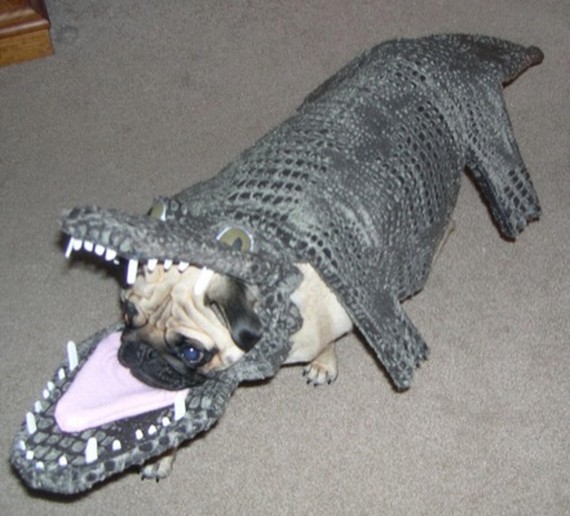
All of us love to see animals in costumes. Some of these costumes are very cute. This collection was originally entitled, "My Owner Is An Idiot!" When you see some of the costumes, you will wonder if the original title wasn't very fitting. This collection was blatantly stolen from Buzz Inn.
More than two dozen rare sea turtles who were cold, hungry and lost were rescued over the US Thanksgiving holiday after having washed ashore on Cape Cod, a spokesman for the New England Aquarium said. The Kemp's ridley species of turtles are being treated at an animal care centre south of Boston for hypothermia, dehydration, and malnourishment, aquarium spokesman Tony LaCasse said.
Sorry! Looked for a photo of the bride and best man; but, couldn't find any. So, the story will just have to do.
A bride and best man are being credited with saving the life of an Australian woman who fell off a boat.
The woman was on a boat near Adelaide, 700 km northwest of Melbourne, on Saturday afternoon when she fell overboard. A wedding party was having photographs taken nearby and the best man immediately jumped in the water and pulled the unconscious woman to the beach, the website Adelaidenow.co.au reported.
The bride, a nurse, then started CPR. Emergency crews arrived on scene shortly after and took her to the hospital.
Shane Daw of Surf Live Saving told the website the bride and best man saved the woman's life.
The McIntosh apple is named after a man named John McIntosh, who discovered the apple tree in 1811 when he was cutting brush on his land in Dundela, Ontario, Canada.
The famed Canadian hockey player, Wayne Gretzky, played minor hockey in his hometown of Brantford, Ontario, when he was a kid. His goal scoring ability back then foreshadowed his future brilliant career. When he was 11 years old, he scored 378 goals during the winter season.
19.2 lb. newborn next to ordinary baby. Photo courtesy: Baby Lifestyles
A baby born in North Sumatra, Indonesia, arrived in the world weighing a whopping 19.2 pounds. That is still 3.92 pounds short of the world record of that of a baby born in 1879 weighing 23.12 pounds. Dr. Binsar Sitanggang said the baby had to be delivered by caesarean section; but, he was so big even that was difficult. The 24.4-inch-long baby was the 41-year-old mother's fourth child. The newborn had a strong appetite from the beginning and had a very loud cry.
"There wouldn't be a sky full of stars if we were all meant to wish on the same one." - Frances Clark
"I am comforted by life's stability, by earth's unchangeableness. What has seemed new and frightening assumes its place in the unfolding of knowledge. It is good to know our universe. What is new is only new to us.
I'm fortunate to have several passions in my life. I am absolutely an eco-nut. I am always trying to find new ways to reduce, reuse, recycle. We, as a species, have done more harm to this planet in the short time we have been here, than any other catastrophe or happening ever has. It's up to us to fix it.
I care about the environment whether it is as small as a single cell or as large as the universe.
I adore creativity and think we can all do more with much less. This earth has enough resources for us all to live comfortably if we all learn to share. Wasn't that a lesson we were supposed to learn in kindergarten?
I also love the bizarre, unusual, the weird and the strange. Be prepared for the odd "different" blog.
 Photo courtesy: Scott Bauer, ARS.USDA




 Posts
Posts


