Hi - We're going to get passionate about the environment; so, grab a beverage, take your shoes off, sit down and get comfy. If global warming is an interest of yours - add your comments, subscribe to the feed and/or become a follower. Don't forget to check out the ads to the right side of the column. There is some very interesting material to be had there. Read, comment, enjoy!!!
The local tradition of lining up to be the first customer of the season at Belt's Soft Serve, Stevens Point, WI. Photo courtesy: flicker.com
Brayden Banks is one lucky did. His grandmother, Michelle Cuestas, waited in line for 43 hours to ensure the six-year-old from Stevens Point, Wisconsin, USA got to be first in line to place an order at the town's ice cream shop when it opened for the season. Everyone wants to be first in line when Belts' Soft Serve opens, which is why Cuestas slept in the Belts' bathroom the first night; then, waited in line with her grandson for 24 more hours until the landmark shop opened for business. It was worth it, she says, because she was making priceless memories with her grandson.
"There can be no happiness if the things we believe in are different from the things we do."
- Freya Madeline Stark
"There is nothing in the world that some man cannot make a little worse and sell a little cheaper; and, he who considers price only is that man's lawful prey."
A ladybug pollinating a flower. Photo courtesy: flickr
Ladybugs are probably the world's most beloved insect - the official bug of six US states and thought in some cultures to be close to God or saints. The Turks associate them with good fortune and call them the "luck bug". They're also one of nature's workhorses.
Voracious hunters of aphids and other plant-eating pests that damage crops, ladybugs and other predator insects add $4.5 billion to the US economy each year through natural pest suppression, according to a study co-authored by entomologist John Losey in 2006.
In the last few years, there has been an unexplained spike in the number of whales washing ashore. While the National Marine Fisheries Service has declared an Unusual Mortality Event (UME) in the Northern Gulf of Mexico, it's more than just oil spills that are causing increased strandings worldwide. And experts are worried.
The numbers of beached whales have been gradually rising, peaking in 2009 with 46 whales coming ashore, and The Department of Environment and Conservation (DEC)is conducting an investigation into what could be causing the rise, reports ABC news.
It could be anything from nutrition issues to sonar that drives whales off course, disorients them, or can even cause internal damage. While there has been a rash of strandings in Florida, including at least 15 pilot whales that washed ashore this week in the Florida keys, experts are quick to point out that the BP gulf oil spill is a possible cause, but not the only factor. Earth Times points out that, "A number of recent strandings in other regions happened well before the Deepwater spill occurred. In March 2009, 194 whales and a small dolphin pod became stranded on the coast of Tasmania, and most did not survive. The previous November, 150 pilot whales died in another mass stranding in Tasmania... In February 2011, 107 whales died on the coast of New Zealand."
NOAA provides this chart of whale strandings in the Gulf of Mexico, showing the marked increase:
The DEC's Doug Coughran says the department is yet to work out exactly what is causing the strandings.
"We don't want to speculate too much, we want to look at it from a scientific perspective, we're entrusted with the protection of the animals in our waters," he said.
"We want to do our best to make sure we have our finger on the pulse to monitor these emerging challenges."
Mr. Coughran says wildlife officers will take samples from beached whales and investigate nutrition and other related possible causes.
So why are so many more whales becoming stranded on shorelines? Experts are befuddled, and it could be a broad range of factors.
Garra Rufa, also known as doctor fish, nibble fish, little dermatologists, kangal fish or reddish log sucker, have nibbled their way into modern medicine one dead skin cell at a time. Doctor fish first caught the attention of the medical field when the overwhelming rate of improvement experienced by psoriasis sufferers who frequented these Turkish spas was brought to light.
These native fish have been used as a traditional medicine for over 400 years in Turkey. Garra Rufa normally occur in the river basins of the Northern and Central Middle East with Turkey, Syria, Iraq and Iran having the majority of the population.
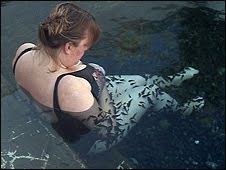
The traditional Turkish spas have bathes big enough to submerge one's entire body; and, bathers have no problem with the communal bathes whose water is filled with these little flesh eaters. The toothless Garra Rufa gently chew away only dead and/or diseased tissue leaving healthy tissue totally untouched. The removal of the dead flesh is accomplished with the help of a powerful enzyme, diathranol, in its saliva to help compensate for the lack of teeth. Some even think there is a curative power in the fishes' saliva.
Ms. Barbara Grayston spent several hours a day in a pool with the "doctor fish" hoping for a miracle cure for her psoriasis. Photo courtesy: bbcnews
The spas are filled with locally-occurring, selenium-rich water in an open-air venue. Locals believe that the clients benefit from the time spent in the open, fresh air; exposing the skin to the selenium-rich water; and, opening the skin below the lesions to allow the healing waters to penetrate to that skin as well. Selenium is a natural skin-healing mineral.
A side-by-side comparison shot of Ms Grayson's back - before and after treatment. The results look phenomenal to me. Photo courtesy: bbcnews
Many Garra Rufa now live and breed in the outdoor pools of Turkish spas where they feed mainly on the skin of patients with psoriasis. Among frequenters of these spas, 87.5% said they experienced great relief from both pain and redness or lesions; but, note they must come back to the spas every few months to keep their skin disease in remission. However, there are people who say their psoriasis or other skin disease has been completely cured by the tender ministrations of these tiny toothless doctors; and, all sufferers hope they may be the next cure.
These fish are capable of doing so much good for so many people. I immediately think of burn victims that must have burnt skin agonizingly removed before treatment can commence. I can't help thinking that this a gentler, kinder way of debriding the area affected.
While visions of fairies, sugar plums; and, lessening pain worldwide danced in my head; corporate greed has found yet another way to exploit our planet and its inhabitants.
These hardy little workers are now legally protected from commercial exploitation in Turkey due to concerns of overharvesting for export. The beauty treatment centres have run amok. They are importing these fish to perform pedicures on clients.
For keeners of this treatment it should be noted that while Garra Rufa can be kept in an aquarium at home; aquarium specimens are not well suited for home applications as the skin-feeding behavior fully manifests only under conditions where the food supply is somewhat scarce and unpredictable.
They are banned in several states in the USA based on health and sanitation concerns; and, animal rights groups are worried about the Garra Rufas' future well-being, treatment and handling.
Animal rights groups have also voiced alarm over the conditions in which the fish are kept. "We do have concerns about the welfare of any fish involved in this practice," a spokeswoman for the RSPCA told the Observer.
"Fish are covered by the Animal Welfare Act. They need a stable environment, with the correct water quality and temperature range. Sudden changes in temperature should be avoided as they can severely compromise welfare and even kill the animals. Water quality is of paramount importance in maintaining healthy fish. Having people bathe in the water with the fish is likely to affect quality, particularly if they are wearing any lotions or other toiletries that could leach into the water. Similarly, chemicals used to disinfect tanks and to clean patients' feet beforehand would have to be non-toxic to the fish."
Most people might think that lighters are the modern way to light a fire. The truth is, lighters were invented before matches. The first lighters were used in the sixteenth centure and the flame was produced with gunpowder.
The next time you go fishing or have a fish dinner, think of this: the refuse dumped into the seas annually is more than three times heavier than the weight of the fish caught each year.
Approximately, one year ago, I blogged about the water crisis in the nation of Yemen resulting in water riots with fatalities; and, threat that Sana'a, Yemen would become the first capital city to die of thirst.
Of all the thirsty countries in the arid Middle East, perhaps the worst off is Yemen, where the mountainous capital city of Sana'a is rapidly running out of water altogether. What water there is in the country's cities is often heavily polluted, causing illnesses for people who drink it because they are too poor to buy bottled water. What's the solution? According to the recent winner of an international prize for urban innovation, Yemenis need to look to their rural past to protect their future of their cities.
Sabrina Faber, a longtime resident of Yemen, noticed while trekking in the countryside that rural residents still employed a traditional way of coping with the country's frequent water shortages: collecting rainwater on mountaintop cisterns. She proposed a variation on this idea for Yemen's cities in her winning entry for the Phillips Livable Cities Award:
Today, many of Yemen's cisterns are in a state of disrepair, or in areas of the country that are now uninhabited. However, Sabrina's RAINS proposal revisits the traditional Yemeni technique of harvesting rainwater from flat rooftops. Her scheme proposes the modification of the existing structures in Sana'a to capture, filter, and store rainwater. Each modified cistern would be capable of generating 10,000 to 50,000 liters of clean, dependable water for domestic use annually.
Here is a short video describing the winning idea submitted by Sabrina Faber.
Launched in May 2010, the Philips Livable Cities Award seeks to "generate practical, achievable ideas for improving the health and well-being of people living in cities." This year's contest drew 450 ideas from 29 countries, eight of which were selected as finalists. A public vote and judging by an expert panel crowned Faber's "Rainwater Aggregation for Yemen" the overall winner at a ceremony this week in Amsterdam, granting her €75,000 (about $125,000) to start working with local contractors and associations to begin implementing the idea on Sana'a buildings.
Second-place winner Manuel Rapoport's project will create safe, portable recreational areas in Buenos Aires, Argentina, by closing streets to motorized traffic on weekends and during public holidays. Other finalists with an environmental bent proposed hosting a competition for designs to transform neglected spaces in Binghamton, New York, and powering streetlights with wind and solar energy.
Sweet success: Natalia Ellingham, 9, from Edinburgh, prepares to tuck in to one of her mother Nadia's haggis chocolates. Photograph: Phil Wilkinson via Scotsman.com
Nadia Ellingham, an artisan chocolate maker from Edinburgh, originally created the chocolates for a Burns supper. They proved so popular among guests that she has now started selling them commercially.
"Most people screw their faces up or look a bit horrified when I tell them I make haggis chocolates, but once I explain how I make them they understand that it does actually make sense," said Ellingham.
Ellingham does not use actual haggis in the chocolate truffles, but instead blends spices including nutmeg, mace and black pepper, as well as oatmeal, in order to recreate the distinctive flavour of haggis.
Ellingham, 43, has also made a number of other unusual-tasting chocolates for her company, Thinking Chocolate, including sundried tomato and basil, cranberry and chestnut, and thyme and orange truffles. She is also in the midst of creating a box of chocolates that tells the story of what goes into a single cask malt whisky – with each chocolate representing a different stage of the process – in collaboration with the Scottish Malt Whisky Society.
Ellingham set up her business two years ago while on maternity leave after the birth of her second child. She works alone in a baker's kitchen near her Edinburgh home, and makes all of her chocolates to order.
"I'm always thinking about chocolate," she says. "It doesn't matter where I am, I'm always thinking about new ideas and flavours. Chefs like Heston Blumenthal are a real source of inspiration when I'm looking at what to put into a truffle."
Joe McGirr, of the Scottish Malt Whisky Society, which has arranged a number of tastings involving Ellingham's chocolates, said: "Nadia has this amazing flair for getting a picture in her head of these experimental ideas that she wants to push.
"The haggis chocolate was amazing. It really takes a risk – you're expecting it to be awful, but then you put it in your mouth and you get all these fantastic spice flavours that make up a haggis."
Gaby Soutar, the Scotsman's food critic, said: "The initial flavour is very un-haggis-like – sweet, with strong notes of pepper, honey and banana. But it only takes a couple of seconds before – ta-da – you can clearly taste something that's reminiscent of MacSween's finest".
Cod and chips prepared in Horseshoe Bay, British Columbia, Canada. Photo courtesy: Wikipedia
Fish and chips became a stock meal among the working classes in Great Britain as a consequence of the rapid development of trawl fishing in the North Sea, and development of railways connecting ports to cities during the second half of the 19th century.
Fish and chips, an icon of British culture (and, one of my personal favourites), celebrated its 150th anniversary in 2010. Douglas Roxburgh is president of the National Federation of Fish Friers, which represents 8,500 fish and chip shops in Britain. He says the idea of pairing deep-fried battered fish with deep-fried potatoes (chips) originated in 1860 with the Malin family of London.
In 1860, the first fish and chip shop was opened in London by Jewish proprietor Joseph Malin who combined "fish fried in the Jewish fashion" with chips. British chips are thicker than American french fries; and, therefore absorb less fat.
Then...out of the mouths of babes, Joseph Malin, 13, suggested his family sell the combo on the streets; and, the idea spread like wildfire.
There are conflicting views about the origins of this tasty treat with some saying the idea goes as far back as the late 1700s; but, Joseph Malin is recognized as the first restauranteer to combine the two - fish and chips.
Photo courtesy: Steve Hicks/Creative Commons via TreeHugger
There are still a small number of rhinos in Nepal; but, there's some good news: A new census of the Greater One-Horned Rhinoceros (Rhinoceros unicornus) shows the population there now stands at 534, an increase of 99 individuals since the last time the census was conducted, in 2008. Another way of looking at it is that the Indian Rhino population has increased 20% in the last two years. What a magnificent improvement. In a fight to prevent this species from becoming extinct, where every single life is precious, an increase of 99 individuals is definitely worth reporting.
As WWF (World Wildlife Federation) reports, 503 of Nepal's rhinos are found in Chitwan National Park, 24 in Bardia National Park, and 7 in Shuklaphanta Wildlife Reserve. The 7 found in Shuklaphanta Wildlife Reserve may seem low until you realize that in 2008 there were just 2 there.
This latest rhino census was conducted by Nepal's Department of National Parks and Wildlife Conservation, WWF Nepal, and the National Trust for Nature Conservation.
The pink area is the historical range of Rhinoceros unicornus; the small red dots are where Indian rhinos currently live. Photo courtesy: Wikipedia via TreeHugger
As is the case with rhino populations across the border in India, as well as across Africa and Southeast Asia, the main threats to rhinos come from poaching for use in Traditional Chinese Medicine. Even though rhino horn has been removed from the official TCM (traditional chinese medicine) pharmacopeia with alternatives encouraged; and, trade in rhino horn banned under international law, demand for rhino horn remains high. Habitat loss due to expansion of areas under human settlement is also a concern, especially in South and Southeast Asia. Very few rhinos survive outside reserves and national parks.
I'm fortunate to have several passions in my life. I am absolutely an eco-nut. I am always trying to find new ways to reduce, reuse, recycle. We, as a species, have done more harm to this planet in the short time we have been here, than any other catastrophe or happening ever has. It's up to us to fix it.
I care about the environment whether it is as small as a single cell or as large as the universe.
I adore creativity and think we can all do more with much less. This earth has enough resources for us all to live comfortably if we all learn to share. Wasn't that a lesson we were supposed to learn in kindergarten?
I also love the bizarre, unusual, the weird and the strange. Be prepared for the odd "different" blog.
 The local tradition of lining up to be the first customer of the season at Belt's Soft Serve, Stevens Point, WI. Photo courtesy: flicker.com




 Posts
Posts


