Showing posts with label sustainability. Show all posts
Friday, June 29, 2012
Norman - Eco-Warrior Extraordinaire
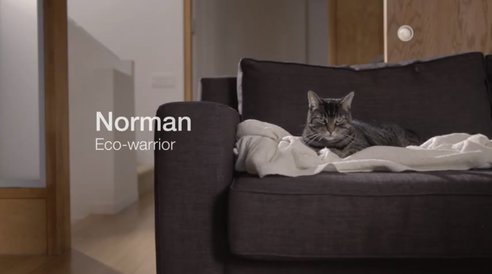
Not since Morris, the 9Lives cat, has there been another star with such charisma, determination of purpose and box office appeal. Norman, eco-warrior, is such a star.
Actually, Norman is the new spokescat promoting Loblaw's new sustainability program. By the end of 2013, the supermarket giant promises to sell only sustainable seafood in all their stores. In the meantime, Norman has a cause, a message and a video. Keep reading to discover the changes he has made in his life; and, then, check out his video at the bottom of the blog.
Norman the 'eco-warrior' cat may be the most environmentally-friendly cat to ever grace YouTube. He may even be more environmentally conscious than most humans.
While pondering what he could do to help the environment, Norman starts looking around the house for simple changes he can make.
Norman researches renewable energy like wind and solar.
His commitment to the environment makes him take a strict approach to energy conservation.
He even makes the switch to reusable bags. And we all know how much cats love paper and plastic bags.
Norman upcycles discarded items into cat toys, and institutes a trash sorting and recycling program in his home, among other green steps.
ALL photos are screen captures from the following video courtesy: WWF Canada.
Thursday, September 18, 2008
Secret EcoVillage In Wales Discovered
Tony Wrench and Jane Faith outside their home in Brithdir Mawr, Wales. Photograph: Phil Rees/Rex Features Unknown to authorities an ecovillage was secretly erected in a Welsh national park and was only discovered during an aerial survey of the park.
It has taken 10 years; but, authorities at Brithdir Mawr, in Pembrokeshire, ruled that the environmentally-friendly settlement reminiscent of Bilbo Baggins’ home in the Lord of the Rings could remain. The buildings, made up of timber-framed, turf-roofed roundhouses, were secretly made by the inhabitants looking for a sustainable way of life. They lived there unnoticed until the aerial survey which was carried out in 1998.
At first, the villagers were threatened with eviction and the authorities said the roundhouses which were built of straw, timber, recycled materials, clay and manure were to be torn down and left to decompose naturally.
However, the villagers fought back believing strongly in their way of life. It took a decade of hearings, court cases and inquiries; but, they finally won and the settlement has been saved from destruction.
Amazingly, the village is very progressive in some ways using solar power and a wind turbine for electricity, compost toilets, reed beds, a workshop and a hay barn.
Water is collected locally, and the villagers survive by working the land and carrying out craft industries such as woodcarving.
After the Pembrokeshire Coast National Park Authority adopted a new policy on sustainable, low-impact developments, it was decided to give the village permission to stay.
A spokeswoman said that meant the community would have to make a "positive environmental and social/economic contribution to the area".
"It was pleasing that support could be given at this stage for this longstanding, complicated case," she said.
The national park authority will review the decision in three years.
It has taken 10 years; but, authorities at Brithdir Mawr, in Pembrokeshire, ruled that the environmentally-friendly settlement reminiscent of Bilbo Baggins’ home in the Lord of the Rings could remain. The buildings, made up of timber-framed, turf-roofed roundhouses, were secretly made by the inhabitants looking for a sustainable way of life. They lived there unnoticed until the aerial survey which was carried out in 1998.
At first, the villagers were threatened with eviction and the authorities said the roundhouses which were built of straw, timber, recycled materials, clay and manure were to be torn down and left to decompose naturally.
However, the villagers fought back believing strongly in their way of life. It took a decade of hearings, court cases and inquiries; but, they finally won and the settlement has been saved from destruction.
Amazingly, the village is very progressive in some ways using solar power and a wind turbine for electricity, compost toilets, reed beds, a workshop and a hay barn.
Water is collected locally, and the villagers survive by working the land and carrying out craft industries such as woodcarving.
After the Pembrokeshire Coast National Park Authority adopted a new policy on sustainable, low-impact developments, it was decided to give the village permission to stay.
A spokeswoman said that meant the community would have to make a "positive environmental and social/economic contribution to the area".
"It was pleasing that support could be given at this stage for this longstanding, complicated case," she said.
The national park authority will review the decision in three years.
Labels:
ecovillage,
sustainability,
wind turbines
Subscribe to:
Posts (Atom)


